
Initiatives
Dark Skies
Light pollution is a very recent problem in historical terms and has only become seriously intrusive in the last 50 years or so.
The night sky is one of the few real ‘mysteries’ remaining, and light pollution limits the ability of astronomers and others to observe stars, planets, and phenomena such as the Northern Lights. Artificial lights at night produce what is known as ‘skyglow’ which reduces the contrast of celestial objects and makes them harder to distinguish.
Light pollution also has clear effects on the behaviour and ecology of nocturnal wildlife, including threatened species such as Barn Owls, Bats and Hedgehogs, not to mention moths. Overall, these effects result from changes in their orientation which may include attraction to, or repulsion from, the brighter environment. This can affect how they search for food, reproduce and communicate. It has been suggested that a single street light has the potential to kill 150 insects per night, reducing an important food source for bats, birds and other species.
Thus, the installation and use of outdoor lighting should be considered carefully. To quote the from the Neighbourhood Development Plan for Tysoe: “Amenity lighting of buildings should be kept to a minimum and its use controlled by sensors and timers where possible.”
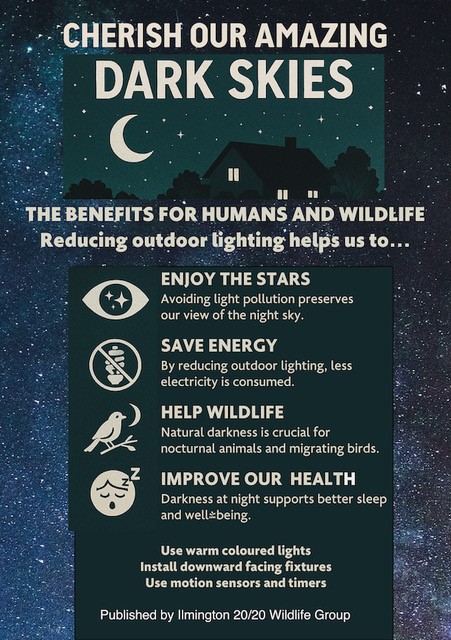
Below is a flyer that a member of the Ilmington 2020 Wildlife Group, created. They have published it in their online newsletter and also had copies printed for distribution to residents, via their Parish Magazine.
Resources & Guides for Dark Skies
| Title | Categories | Link |
|---|